


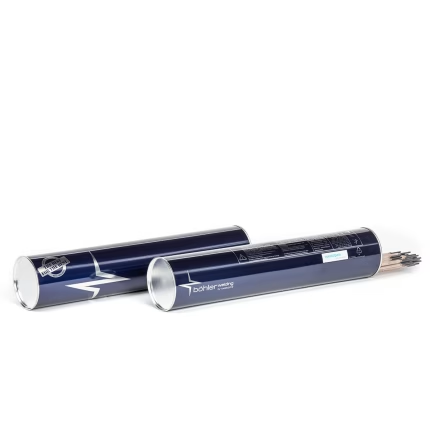
BÖHLER FOX C 9 MV
Coated electrode, basic, creep-resistant
Standard
- EN ISO 3580-A
- EN ISO 3580-B
- AWS A5.5 / SFA-5.5
- AWS A5.5M
- E Z CrMo91 B 4 2 H5
- E6215-9C1MV H5
- E9015-B91 H4
- E6215-B91 H4
BÖHLER FOX C 9 MV LNi Specifications and Typical Applications
BÖHLER FOX C 9 MV LNi is a basic-coated, alloy-cored stick electrode. The 9Cr-1Mo-VNb weld metal exhibits a fully tempered martensitic microstructure and possesses favorable mechanical properties after post-weld heat treatment.
Similar alloyed creep-resistant steels and castings:
Kimyasal bileşim, kaynak sonrası ısıl işlemden sonra yüksek sünme dayanımı ve süneklik sağlamak üzere optimize edilmiştir. İz element seviyesi düşüktür (Bruscato < 15). Mn + Ni içeriğinin %1,0 ağırlıkça altında sınırlandırılması sayesinde Ac1 sıcaklığı kesin olarak 780 °C’nin üzerindedir. Bazik örtüsü, kaynak metalinde düşük seviyede difüze olabilen hidrojen sağlar.
cast steels
Similar creep-resistant steels and castings made from similar alloys:
- 1.4903 X10CrMoVNb9-1
- 1.4955 GX12CrMoVNbN9-1
- ASTM Grade 91, T91, P91, F91, FP91, WP91, C12A
- 10Cr9Mo1VNbN
- STPA28, STBA28
BÖHLER FOX C 9 MV LNi Chemical Analysis
|
Weight % |
C |
Ni |
Mon |
Feature |
Si |
Mon |
V |
Nb |
N |
|
Percent by weight |
0.10 |
0.20 |
0.80 |
9.0 |
0.10 |
1.1 |
0.20 |
0.05 |
0.04 |
Mechanical Properties of BÖHLER FOX C 9 MV LNi Weld Metal – Typical Values (Minimum Values)
Status: T (Tempered – 760 °C / 2 hours)
|
Description |
70 (≥47) |
550 °C |
|
Yield Strength Rp0.2 (MPa) |
580 (≥ 530) |
410 (≥ 280) |
|
Tensile Strength Rm (MPa) |
710 (≥ 620) |
460 (≥ 330) |
|
Elongation A (L0=5d0) (%) |
19 (≥ 17) |
17 (≥ 15) |
|
Notch Impact Energy ISO-V kV (J) |
70 (≥ 47) @20 °C |
40 (≥ 27) @0 °C |
Current Type / Polarity:
- Current Type / Polarity: DC+
|
Current (A) |
Value |
Work Data |
|
2.5 |
250 |
70–100 |
|
3.2 |
350 |
100–145 |
|
4.0 |
350 |
140–190 |
Electrode Specification:
FOX C 9 MV LNi / E ZCrMo91 B / E9015-B91
Redrying
- 300–350 °C / 2 hours
Welding and Heat Treatment Instructions
The temperature between the preheating and the weld pass should be controlled between 200 and 350 °C. To optimize impact toughness, a welding technique that ensures a thin weld bead and low heat input is recommended.
After welding, the weld temperature must be lowered below 100 °C to allow the martensitic transformation to complete. Post-weld heat treatment (PWHT) is typically performed at temperatures between 750 and 770 °C for a minimum of 2 hours.
PWHT for castings may require a lower holding temperature, such as approximately 730 °C; however, a longer holding time, such as ≥ 8 hours, should be applied.
During the period between welding and the final PWHT, holding the material at a temperature above the dew point or storing it in a humidity-controlled environment is strongly recommended. For thick-walled components, a hydrogen-removal heat treatment at temperatures between 260 and 400 °C may be applied before cooling to room temperature.
All information provided is based on careful review and extensive research. However, no liability is accepted for its accuracy, and the information is subject to change without prior notice.
Approvals
- Class
Website:
All information provided is based on careful review and extensive research. However, no liability is accepted for its accuracy, and the information is subject to change without prior notice.
Related products
BÖHLER FOX Green
Coated electrode, unalloyed, basic-coated
Standard
- EN ISO 2560-A
- AWS A5.1 / SFA-5.1
- E 42 5 B 4 2 H5
- E7018-1H4R
Class
A basic-coated electrode for ductile and crack-resistant fusion welding of unalloyed and low-alloy steels. The weld metal exhibits excellent toughness values down to –40 °C. The strength of the weld metal is relatively low compared to other basic-coated electrodes and is compatible with the strength of unalloyed steels. High toughness values are maintained even in the aged condition. Low hardness level (≤ 210 HV).
Bu elektrot, the welding of ammonia tanks için gerekli şartlara son derece uygundur.
Electrodes
Coated electrode, unalloyed, rutile-coated
Standard
- EN ISO 2560-A
- EN ISO 2560-B
- AWS A5.1 / SFA-5.1
- AWS A5.1M
- E 42 0 RC 1 1
- E 4313 A
- E7018-1
- E6013
Class
- E 38 2 RB 1 2
- E4916-1H4 R
- E7016-1H4R
- Ensures non-porous, good root penetration even in narrow air gaps
Applications:
Rutile-coated electrode. Minimal spatter formation and self-shedding slag; provides fine, wavy, and smooth weld beads with a notch-free transition between the weld metal and the base metal.
BÖHLER FOX SPE
Coated electrode, unalloyed, rutile-coated
Standard
- EN ISO 2560-A
- EN ISO 2560-B
- AWS A5.1 / SFA-5.1
- AWS A5.1M
Coated electrode, unalloyed, rutile-coated
- E 42 5 B 3 2 H5
- E4918-1 AU H5
- E7018-1
- E6013
Class
Tüm pozisyonlarda (aşağı doğru dikey dahil) iyi kaynak kabiliyetine sahip Classifications.
Mükemmel boşluk doldurma ve ark başlatma özellikleri vardır.
Punta kaynağı ve montaj uyum kaynakları için uygundur.
Sanayi ve ticaret için genel amaçlı; montaj ve atölye kaynaklarında kullanılır.
Reviews
There are no reviews yet.